

How Inclusive Is Bamberg?
Why is this issue important?
About 16% of students have a disability that makes studying difficult and sometimes face additional obstacles in their daily university life because colleges and universities are often not designed with them in mind. (DHZW, 2023, p. 5) (https://www.studierendenwerke.de/fileadmin/user_upload/Publikationen/beeintraechtigt_studieren_2021.pdf) For people with mobility impairments, obstacles such as a lack of elevators or heavy doors become real barriers every day. Other types of barriers are also widespread. Many rooms are too bright or too loud, which can be stressful for people with migraines, autism, or sensory processing disorders.
Added to this is the bureaucratic burden involved in obtaining accommodations. Applications, medical certificates, and long wait times are part of everyday life for many. People with disabilities have the abilities, the will, and the eligibility to study. Furthermore, under Article 24 of the UN Convention on the Rights of Persons with Disabilities, they have the right to equal access to education. Nevertheless, on their path to graduation, they repeatedly encounter the structural problems of our non-inclusive university.
The need for inclusion does not stop at the doors of lecture halls. More than 16% of all residents in Bamberg live with a disability (SGB IX structural statistics, ZBFS Bavaria, as of December 31, 2024) and face barriers every day—whether when using public transportation, at school, or in the job market. Promoting inclusion and accessibility in the city is the responsibility of the city council. But how much attention do Bamberg’s political parties give to this issue? We reviewed and critically analyzed all the campaign platforms from the 2026 local election campaign.
Inclusion in the 2026 Local Election Campaign in Bamberg
The following table is based on the election platforms of the elected city council slates for the 2026 Bamberg local election, which are available online. The parties are listed in order of the number of seats they were allocated, based on the election results from March 8, 2026. The information provided does not constitute a scientific analysis of the election platforms. It was compiled to the best of our knowledge and belief but may be subject to individual interpretations.
The fact that some parties have split since the election (particularly the CSU/CSB) and may no longer hold the original positions stated in their election platforms is not taken into account. For “Bambergs Mitte,” we refer to the 2020 election platform, as we were unable to find a more recent one online at the time of our research.
Furthermore, we have decided to exclude the AfD from our analysis. In several federal states, the party has been classified by the Office for the Protection of the Constitution as a confirmed far-right extremist organization, and in Bavaria as well, it is under observation as a suspected case. We do not wish to draw attention to this ideology in our flyers and thereby give the impression that the AfD is a party like any other. There is ample evidence from within the party’s ranks of the ableism that prevails there. Maximilian Krah, for example, referred to the Tagesschau, which uses simple language, as “news for idiots” (Kaiser-TAZ, Aug. 18, 2024). Far-right politician Björn Höcke described inclusion as an “ideological project” from which the education system must be “freed,” since it “does not help our students progress” and “does not make them more productive.” It does not help “turn our children and young people into the skilled workers of the future.” (Müller & Baumgärtner, Spiegel, August 9, 2023). Similar statements aimed at restricting inclusion can also be found in the AfD’s platform for Saxony-Anhalt. To cite just one example: “The school’s task is not social and psychological support, nor integration and inclusion, but solely the teaching of basic skills (reading, writing, arithmetic) and educational content.” (AfD Election Platform, 2026) We agree that a detailed examination of the AfD from the perspective of inclusion is therefore unnecessary in any case.
Analysis
Many parties have a glaring gap in their platforms regarding positions on inclusion. In total, there are 70 instances in the election platforms where no position on these categories can be found. In addition, there are 54 instances of support.
It is striking that there are nevertheless no substantive rejections. While many political issues were hotly debated during the Bamberg election campaign, no party actively opposes additional measures for inclusion. Furthermore, some key areas of life are not addressed. For the categories “Accessibility in public facilities,” “More accessible spaces in everyday life,” and “Accessible municipal information services,” there are more question marks (7 each) than expressions of support.
The numbers are even higher for the topics “Inclusive education system” (9 question marks) and “Accessible cultural offerings” (8 question marks). However, the lack of clear positions is most pronounced—with 11 question marks each—on the topics “Accessibility standards for new buildings” and “Inclusion in the workplace.” Given that Bamberg has several inclusive residential facilities and projects, this is surprising. In addition, the city is home to “Lebenshilfe Bamberg,” a major employer. Nevertheless, the topic barely appears in the platforms, as if work were to shape only the lives of people without disabilities.
Inclusion at the University of Bamberg, Points of Contact, A Look Back at Our Campaign, Areas for Improvement at the University
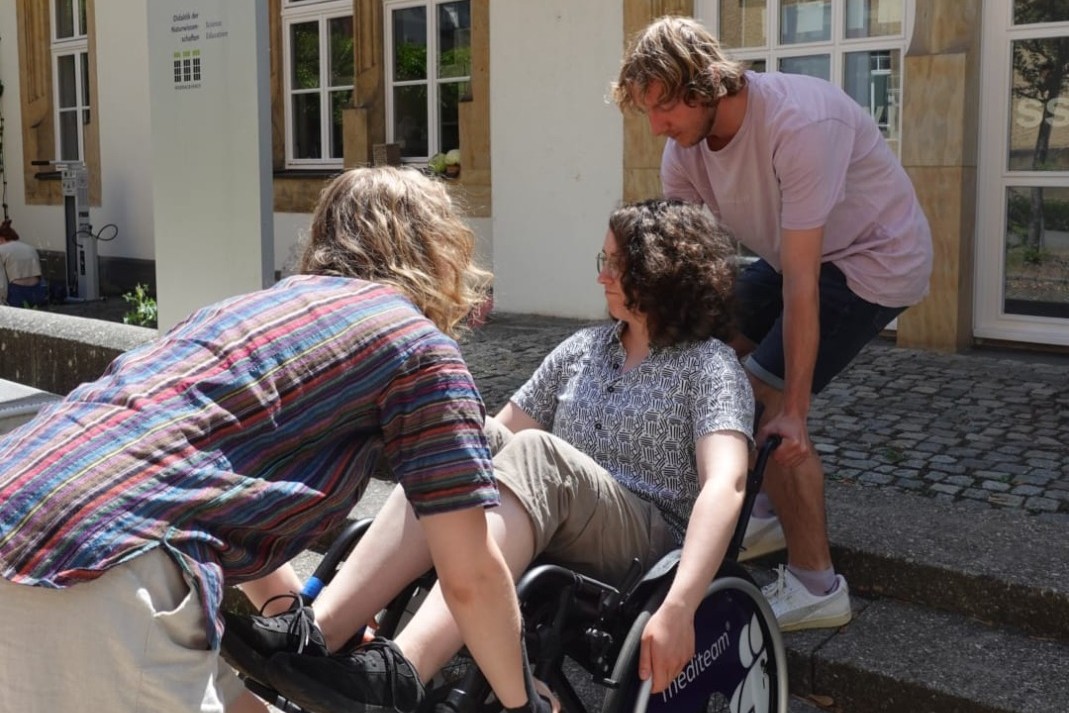
The responsibility to address the issue of inclusion does not end with policymakers. It is a responsibility that we all share—and thus our university as well. To draw attention to this, we looked around campus, asked around, conducted a wheelchair obstacle course (see cover photo), and spoke with university officials about current shortcomings. What we noticed is outlined below. It’s important to note that we inevitably overlook many things because we are not currently directly affected and cannot identify every barrier created by our non-inclusive society.
To date, the University of Bamberg has no reliable data on accessibility needs on campus. As a result, voices that would draw attention to various obstacles are likely going unheard and overlooked. Furthermore, while the university now has a plan—in the form of a slide deck that survey’s needs—to break down barriers in seminars beyond just physical obstacles, However, we know from students across a wide range of faculties that instructors take this slide deck into account only in very few cases at the beginning of the semester. We therefore urge the university to provide faculty members with adequate training so that they can raise awareness of this issue with the necessary sensitivity and address individual needs. Until this step is taken, faculty members can take the initiative to inform themselves and attend workshops on the topic. These can be found under “Information for Faculty” on the “Study and Disability Resource Center” page (https://www.uni-bamberg.de/bafbs/).
In addition, there are areas on campus that are not accessible at all. These include, for example, Building U5. Historic preservation regulations make it particularly difficult, especially in the city center, to implement measures ensuring that all rooms and libraries are accessible to everyone. Furthermore, tight budgets and insufficient funding allocations prevent necessary construction measures from being carried out or allow other structural problems to persist. As a result, university employees who, due to visual or hearing impairments, for example, would be entitled to certain assistive devices from their health insurance provider cannot apply for them because they are only offered temporary contracts that are not renewed or are renewed only for short periods. However, applying to the health insurance provider requires long-term and reliable employment relationships.
We believe that the city of Bamberg, the Free State of Bavaria, and the federal government all have a responsibility to provide sufficient funding. The university must convey this demand to policymakers in its discussions with the relevant Ministry of Science in order to draw attention to the issue.
We still have a long way to go on the path to an inclusive society. We hope that our efforts can at least help a little in bringing us closer to this ideal.
Until then, let’s keep going!
If you rely on accessibility features or notice areas on campus that are not accessible, you can contact the following resources:
– Contact Point for Students with Disabilities (https://www.uni-bamberg.de/bafbs/ )
– Anti-Discrimination at the University of Bamberg (https://www.uni-bamberg.de/antidiskriminierung/antidiskriminierungsstelle/)
– Social Counseling for Students from the Würzburg Student Services Organization (https://www.swerk-wue.de/bamberg/beratung/sozialberatung)
– Representative Body for Employees with Severe Disabilities at the University of Bamberg (https://www.uni-bamberg.de/sbv/)
This article was written by the Social Affairs Working Group.